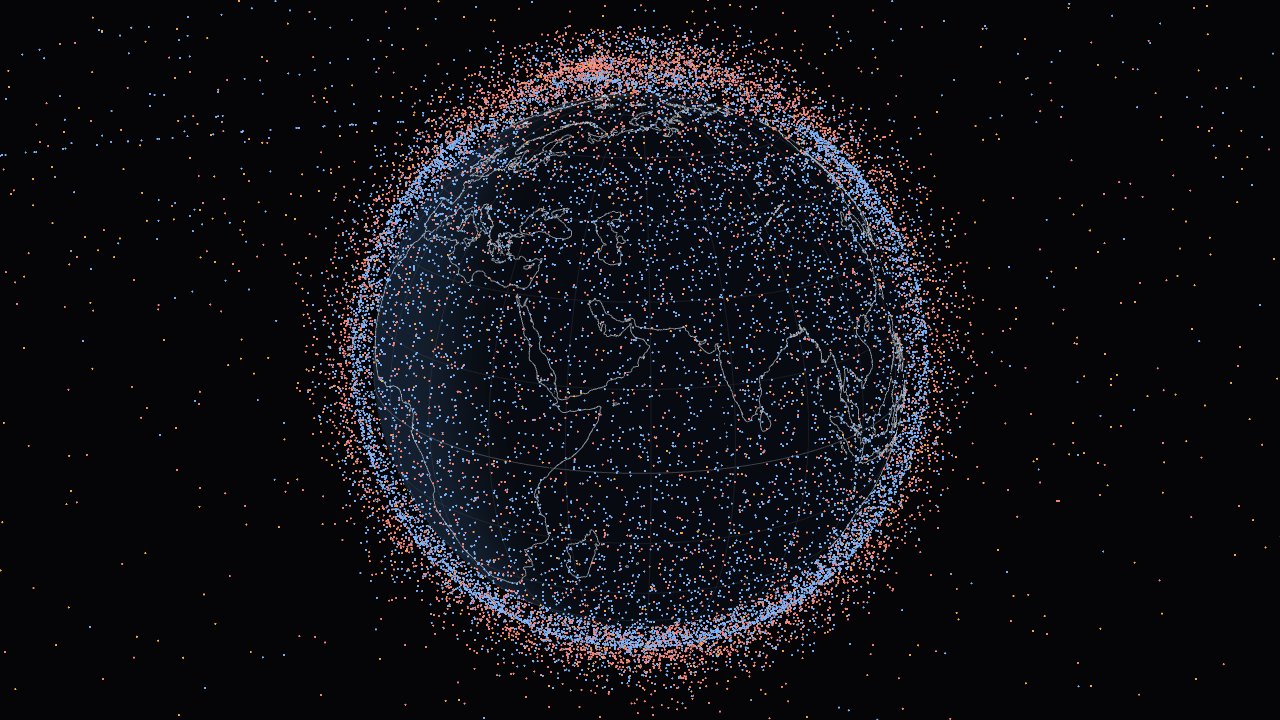
Two engineering tools for the space around Earth: the tracked debris population, and the trapped radiation of the Van Allen belts. Both run entirely in your browser.
The public catalog on a 3D globe, propagated with SGP4. Filter by object type, orbit regime, owner, radar size or launch, and isolate fragmentation clouds such as Fengyun-1C or Cosmos 2251.
Spatial density by altitude, Gabbard diagrams, inclination–altitude maps and population counts
Debris exposure for your orbit: tracked-object flux and ORDEM / MASTER small-particle proxies
Close-approach screening against the whole catalog, with radial, in-track and cross-track miss components
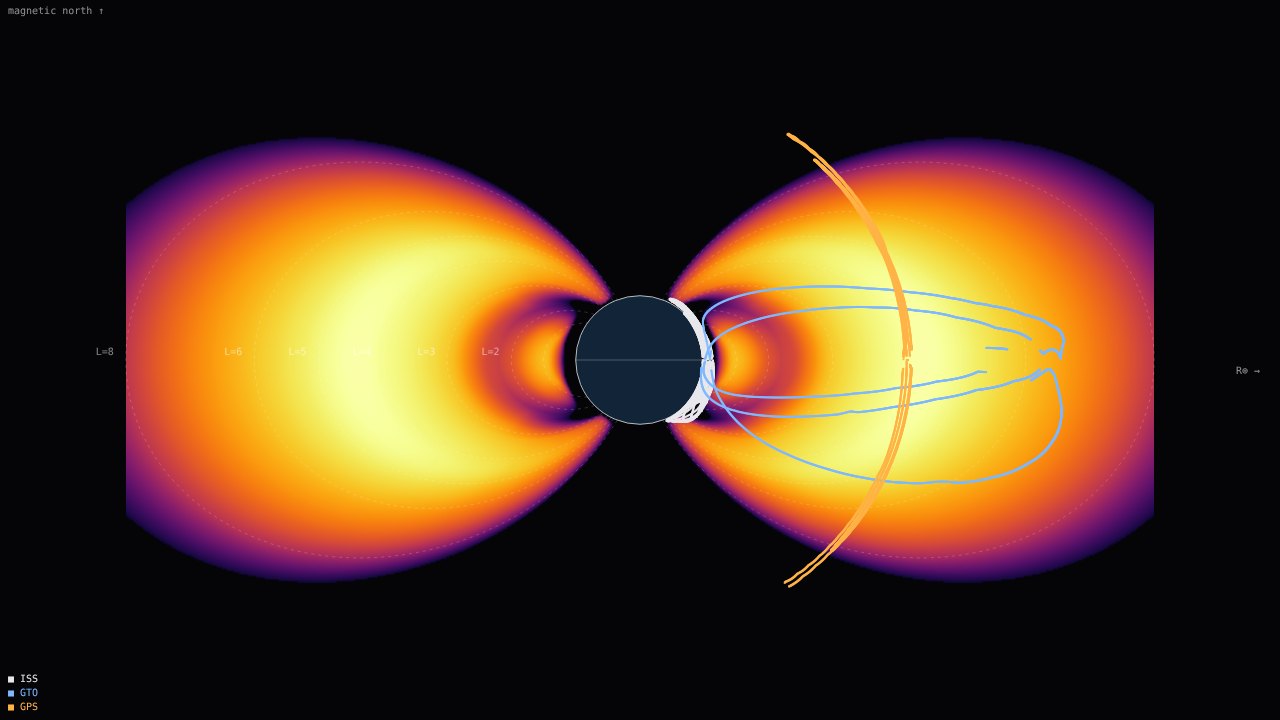
Compare up to six orbits over any mission length. The tool samples each trajectory through the AE8 electron and AP8 proton models and accumulates what the spacecraft sees.
Orbit-averaged spectra, cumulative fluence and L-shell exposure
Total ionizing dose behind aluminium (sphere or slab), with a design-margin option
South Atlantic Anomaly maps, belt passes and a belt cross-section showing where each orbit sits
Both tools take the same orbit inputs: a preset, classical elements (perigee, apogee, inclination, node, argument of perigee and mean anomaly at a UTC epoch), or a pasted or uploaded two-line element set or OMM JSON record. Everything runs through the same SGP4/SDP4 propagator, so a TLE from CelesTrak and a hand-typed orbit behave the same way. Any orbit can be copied back out as a TLE. Analyses can be exported as CSV, and the radiation tool encodes its cases in a shareable link.
Models and data
Catalog. A Space-Track.org snapshot of the public GP catalog retrieved October 23, 2026 (USSPACECOM / 18th & 19th Space Defense Squadrons), with CelesTrak SATCAT metadata. You can load a newer TLE or OMM file in the visualizer; it stays in your browser.
Trapped particles. NASA AE8/AP8 (NSSDC), tabulated with NASA GSFC's radbelt using the same cutoff-normalised interpolation as the models' own routine. Against direct model calls the median error is about 1%.
Geomagnetic coordinates. McIlwain L and B/B₀ from IGRF/DGRF on a geodetic grid, at the 1970 model epoch or the present-day field.
Dose. Continuous-slowing-down transport with NIST PSTAR/ESTAR tables. Proton dose matches CREME96 within 3% for the standard 1,000 km, 35° check case.
Small debris. Screening proxies for NASA ORDEM 3.1, ESA MASTER-8 and NASA MEM R2, digitised from Horstmann et al. (2021).
These are screening and education tools. They are not substitutes for AE9/AP9, SHIELDOSE-2, ORDEM 3.2 or conjunction data messages. Each tool's Method tab states its assumptions, validation and limits. Build scripts for every data table live in scripts/space.